The Verb That Turns a Headline into a Claim
Learn to read headline verbs against a report’s qualifications, so you can tell what is established, alleged or still uncertain before sharing it.

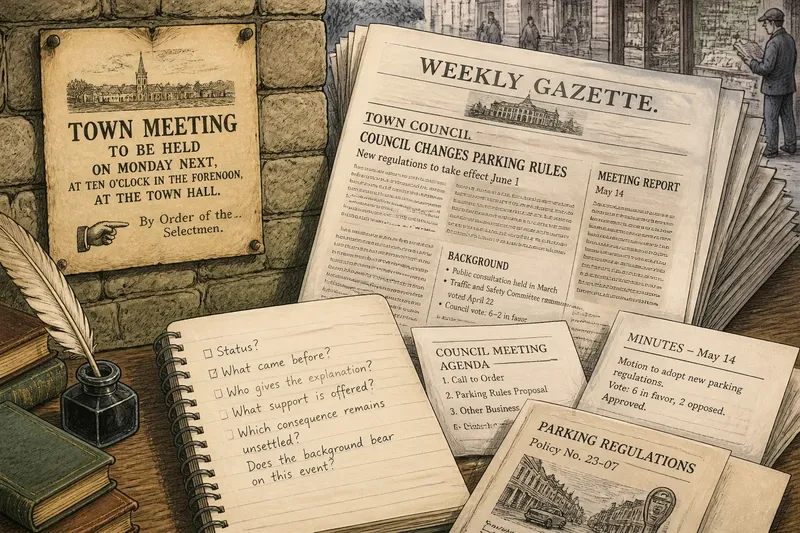
You read that a council “blocked” a housing plan, then open the report and find that officials have only asked for revisions. That gap is easy to miss when the headline is short and the verb sounds decisive. Reading headline verbs carefully helps you see whether a report supports the certainty its wording suggests.
The issue is not that headlines must reproduce every qualification in a report. They have little room, and a strong verb can make a complex development legible. The useful question is narrower: what does this verb say happened, and does the report say the same thing with the same degree of certainty?
Why does the headline sound more certain than the report?
A headline usually has to compress a longer account into a few words. In that compression, a tentative action can become a completed one, or a source’s interpretation can sound like an established fact. The writer may be summarising the likely significance rather than the precise procedural status.
Verbs carry much of that change. “Proposed” identifies an offer or plan; “approved” says a decision was made. “Could affect” describes a possibility, while “will affect” presents an expected outcome as settled. “Says” attributes a claim to someone; removing that attribution can make the claim appear to belong to the report itself.
Open the report and find the sentence or passage that appears to support the headline. Then ask who is acting, what action has actually occurred, and whether the account marks it as completed, alleged, expected or disputed. Do not rely only on a search-result snippet or social post: those may omit the report’s qualifications.
Start by locating the report’s own wording, not by deciding whether the headline feels fair.
What if a verb makes a proposal sound like a decision?
This is a common source of confusion in stories about councils, courts, universities and public agencies. Words such as “rejects”, “approves”, “blocks” and “clears” can imply that a formal decision has been made. But the report may describe a recommendation, a draft, a request for more information or a vote that has not yet taken effect.
The cause is often a compressed account of a multi-stage process. A committee may recommend that a plan be refused, while the full council still has to decide. A regulator may announce a review without reaching a finding. The headline’s verb can jump ahead of that sequence even when the report describes it accurately further down.
Check for procedural nouns and verbs around the relevant passage: “recommendation”, “proposal”, “draft”, “review”, “referred”, “awaiting” or “subject to approval”. These details help distinguish an action taken from an outcome still pending. If the report says a decision is expected later, do not read the current action as the decision itself.
Say you see a headline claiming that a school board “bans” a book. The report says a committee has recommended removing it from one course, with a board vote still to come. The more careful reading is that a recommendation has been made, not that a ban is in force; the observable difference is whether the report records a final decision or a pending one.
What if the headline turns an allegation into a fact?
Words such as “accused”, “alleged”, “claimed” and “charged” are not interchangeable with “committed”. They identify the status or source of an assertion. A headline that says a company “misled customers” makes a different claim from one saying a regulator “accused the company of misleading customers”.
The usual cause of trouble is attribution getting lost between a source and the headline. A report may explain that a complaint, lawsuit, official or witness made an allegation, while the headline states the allegation in the outlet’s own voice. Even when the source is credible, the reader still needs to know whose account is being reported and whether it has been accepted or contested.
Look for attribution in the report: who made the claim, what evidence the report describes, and whether a response or denial is included. A denial does not by itself settle the matter, just as an allegation does not establish it. The wording should preserve that distinction rather than ask the reader to supply it.
If the headline gives no source for a consequential accusation, check whether the report identifies one before treating the claim as established.
What if a strong verb hides a weaker finding?
Some verbs suggest a level of proof that the report does not actually claim. “Proves” implies that a question has been resolved; “confirms” suggests that a point has been established. By contrast, “indicates”, “suggests” and “is consistent with” leave room for other explanations.
This mismatch often appears in accounts of technical, medical or legal findings. A report may describe an association, an early assessment or evidence that supports one interpretation without excluding others. A headline that says a factor “caused” an outcome may be stronger than a passage that says it “may have contributed”.
Compare the headline with the report’s own verbs and qualifiers. Notice whether the report uses phrases such as “according to an initial assessment”, “the evidence does not establish” or “officials have not determined”. These are not decorative caveats: they tell you how far the account’s conclusion reaches.
When a report uses cautious language, retain that caution in your own retelling. “The report suggests a link” is not a weaker version of “the report proves a cause”; it is a different claim.
How can you compare headline verbs with the report?
Use a short sequence rather than trying to judge the headline by tone alone. First identify the verb that carries the main claim. Then locate the relevant passage in the report and compare the action, attribution and certainty expressed there.
- Mark the central verb. Find the word that says what happened, such as “orders”, “admits”, “warns” or “ends”.
- Find its support. Search the report for the event or statement the headline appears to summarise.
- Check who is speaking. Note whether the claim comes from the reporter, a named person, an organisation, a document or an allegation.
- Check the status. Decide whether the report describes a completed action, a proposal, an expectation or a disputed account.
- Compare the strength. Ask whether the report’s wording is more qualified than the headline, and identify the qualification that matters.
- Retell it at the report’s level of certainty. Keep the attribution or uncertainty if the report does.
For example, imagine a headline says that a court “clears” a mayor. The report states that a judge dismissed one procedural claim, while another part of the case remains active. The comparison points to a narrower description: one claim was dismissed; the report does not say the entire matter is resolved.
Which headline verbs deserve a closer look?
No verb is automatically misleading. The same word can be accurate in one report and too strong in another. These questions can help when a headline’s wording feels more conclusive than the details beneath it.
Does “admits” mean the person accepted the whole accusation?
Not necessarily. The report may say someone acknowledged a limited fact while disputing the interpretation attached to it. Check what was actually acknowledged and whether the headline extends that admission.
Does “warns” describe a prediction or a confirmed outcome?
Usually it reports a person’s warning, not proof that the predicted event will happen. Find who issued it and whether the report presents it as a forecast, a possibility or a settled consequence.
Does “reveals” mean the information was previously unknown?
It may simply mean that a report or document contains information the headline considers notable. Check whether the account establishes something new, or whether it restates a claim already made by a source.
Does “ends” mean the whole process is finished?
Sometimes it refers only to one stage, arrangement or part of a dispute. Look for the scope of the action and any remaining decisions or proceedings described in the report.
What should you do when the wording still feels unclear?
Sometimes the report itself does not settle what a compressed verb means. The underlying event may be unfolding, the relevant document may not be included, or different sources may describe the same action differently. In that situation, note what is clear and leave the rest open rather than choosing the strongest interpretation.
It can help to replace the headline’s verb with a more literal description. “The agency announced a review” says less than “the agency exposed wrongdoing”, but it may match the report more closely. If the report attributes a claim, keep the attribution: “the group says the policy will change” is clearer than turning that statement into a definite prediction.
When the distinction matters, look for a linked decision, statement or document named in the report. Read the relevant passage rather than assuming that a headline’s summary settles the question. If no further detail is available, that absence is a reason to withhold certainty, not to fill the gap with an inference.
Headline verbs are compact signals about action and certainty. Reading them against the report lets you keep the useful summary while noticing where it moves beyond the underlying account. The next time a verb seems decisive, ask what the report actually records—and preserve that wording when you pass the story on.