A Developing Story, Read in Three Passes
A developing story read in three passes helps you track what changed, distinguish new evidence from revised wording, and avoid treating a live account as settled.
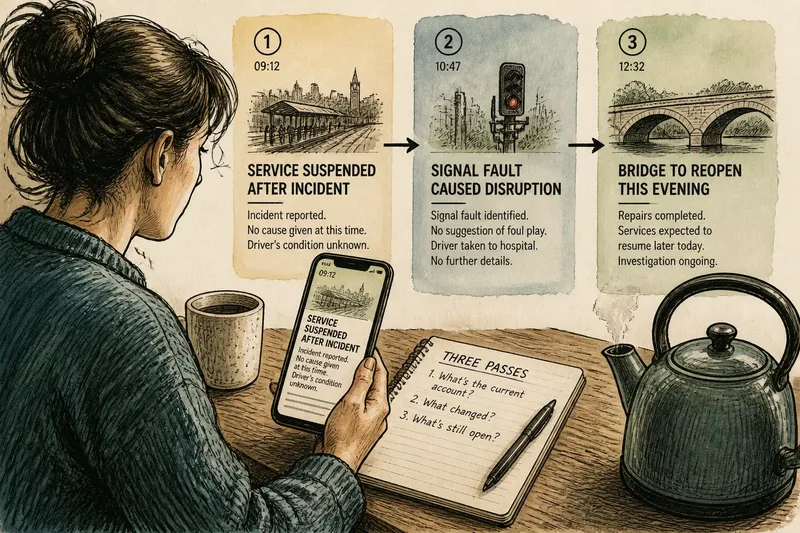
Your phone lights up beside the kettle: a local station has suspended service after an incident. The first alert gives no cause; a later update mentions a signal fault. Reading a developing story in three passes helps you see how the account changes, rather than letting its newest wording erase what was previously unknown.
What does the first pass establish?
Begin with the report’s time and scope. Is it describing an event that is happening now, an official announcement about an earlier event, or a developing explanation? Note the headline’s central claim, then check whether the body narrows or qualifies it.
Verbs carry clues. “Announced” identifies an act of communication; “suspects” signals a working belief; “confirmed” makes a stronger claim but still depends on who is speaking and what they know. A headline may compress those distinctions, so read the sentence that supports it.
Keep a short note of the report’s present shape: what is said to have happened, when the account was published or updated, and what the outlet says is still being established. That gives you a reference point for later changes.
Write down the claim in the report’s own terms before interpreting it.
How can you spot what changed?
On the next pass, compare the current account with an earlier version or update note. Look for changes in three places: the event described, the evidence or source offered, and the degree of certainty. A new detail can extend an account; a changed detail can alter it.
- New information: a source adds a detail that does not contradict the earlier account; keep it as an addition.
- Changed account: the report replaces or withdraws a detail; treat the earlier version as superseded, not as an additional fact.
- Narrower wording: a broad claim becomes more specific; use the narrower version and note its limits.
- Unexplained edit: wording has changed without a visible note; avoid making claims about what the earlier version said unless you have a saved copy.
- New attribution: a claim is now linked to a named person, agency or document; retain that source when describing it.
- Same uncertainty: the report still says a point is unknown or under review; do not treat surrounding detail as an answer to it.
These distinctions matter because a live page can look more settled simply by becoming longer. More words do not necessarily mean that the central question has been resolved.
Say you saved an invented alert stating that a bridge was closed after a vehicle struck a barrier, with the driver’s condition unknown. The next version adds a fire service statement that one person was taken to hospital, but gives no diagnosis. You would record the transport as new attributed information, keep the person’s condition open, and avoid repeating the earlier alert’s broader wording as though it described the latest account.
When should you look beyond one outlet?
A single outlet’s update trail is useful for following its account over time. A second outlet can help when a central detail is disputed or consequential. The point is not to count how many pages repeat a claim, but to see whether they rely on distinct sources or the same original statement.
If two reports use different language, compare the source each names and the time each account was published. One may be describing an official announcement while another reports what a witness said. Those accounts need not contradict each other, but they do not carry the same basis.
For a routine update, the original report and its timestamp may answer your question. If the accounts diverge, keep the difference visible until a source or document clarifies it.
What questions help when the account keeps changing?
What does a correction change?
A correction means an earlier detail was wrong and has been amended; it is different from adding information that was not available before. Check the correction note and use the corrected wording when describing the current account.
Can stronger wording mean stronger evidence?
Not by itself. Compare the newer phrase with the source or evidence offered alongside it; if no basis is given, treat the shift in confidence cautiously.
What should I do when an update removes a detail?
Check for a correction or explanation before repeating the removed claim. If the reason is not stated, describe only what the current report supports and leave the history of the edit open.
When is a story still unresolved?
It remains unresolved when a relevant question is explicitly open, competing accounts persist, or the report has not supplied a basis for its conclusion. A fuller update can still leave that central point unanswered.
How should you describe the latest version?
Before sharing or discussing an update, state what the current account says and identify any change that affects its meaning. Keep the date or update context if it matters, and avoid turning a possibility into a settled event through shorthand.
For this subject, the useful habit is to reread the account as a changing record, not as a finished verdict: track what changed, what supports the newer wording, and what remains open. That makes it easier to recognise when an update answers a question—and when it merely gives the story a new shape.