Interview, Document or Post: What Can Each Source Show?
Learn what interviews, documents and social posts can directly establish, so you can trace a claim to its source without stretching the evidence.

You read that a council has changed a local service, then open a neighbour’s post, a quoted interview and a council notice. Each seems to support the headline, but they do not establish the same thing. To assess a news claim, first identify what each source can show directly—and keep its limits attached.
What exactly is the claim?
Before comparing sources, write the claim in plain language. “The service will close” is different from “a resident says staff told her it would close” or “the council is considering closure”. Those sentences make different assertions and call for different evidence.
Split a complicated claim into parts: an event, a decision, a person’s experience, a date or a motive. A single source may speak clearly to one part and not to the others. A post describing a meeting, for instance, may report what its writer heard without establishing what decision was formally made.
Underline the words that carry the claim: “approved”, “said”, “published”, “happened”. Then ask what you would need to see or hear to know that each word is accurate.
What can an interview establish?
An interview records what a person says. It can directly establish that the speaker made a particular statement in the interview, provided the recording or transcript is authentic and the words have not been misleadingly edited. It can also offer testimony about what that person experienced, observed or understood.
That is not the same as independently establishing that every detail in the account is true. A witness may be sincere yet mistaken about a time, a name or what happened beyond their view. Someone describing a meeting can tell you what they recall hearing; their account alone may not establish the wording of a resolution or what all attendees understood.
Check who is speaking, what access they had, and whether the account is direct or second-hand. Notice whether a reporter’s question, a short extract or an edited clip changes the apparent meaning. For a claim about an official decision, treat an interview as evidence of the speaker’s account and look for the record that would document the decision.
What can a document establish?
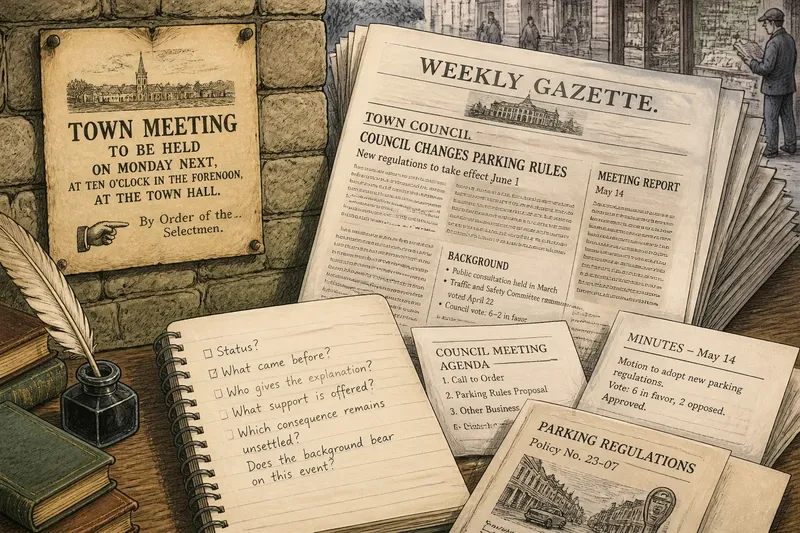
A document can show what its author or issuing body recorded, instructed, proposed or published. A signed notice may establish that an organisation issued that notice; minutes may record what a meeting documented; a draft may show that a proposal was under consideration. The document’s status matters as much as its wording.
Check the title, date, author or issuing body, and whether the copy is complete. Look for markers such as “draft”, “approved”, “superseded” or “for consultation”. A document can be genuine but outdated, partial or written for a narrow purpose. It may establish what was recorded without proving that the record captures every relevant event or that the plan was carried out.
Read the surrounding section rather than relying on a cropped passage. Definitions, footnotes and qualifications can change what a sentence applies to. If a notice says a service “may be suspended”, do not restate that as a confirmed closure.
What can a social post establish?
A social post can show that an account published particular words, images or a video, if the post and account are authentic. It may also offer a timely eyewitness account or point towards material worth checking. But the platform’s timestamp, the account name and the post’s apparent location do not by themselves establish who created the material, when an event occurred or what happened before the clip began.
Check whether the account belongs to the person or organisation named, and whether the post links to an original source. Look for a full video, an uncut image sequence or a document outside the post. Captions can describe footage inaccurately, and a repost can lose the original context. A post that quotes an official also does not become the official record merely by repeating its words.
Keep the claim narrow: “An account posted a video captioned as showing the station” is different from “the video proves what happened at the station”.
How do you match the source to the claim?
Say you see a neighbourhood post claiming that a library has closed. Imagine the post includes a photograph of a locked entrance, while an interviewee says staff told them the closure was permanent. The photograph may show a locked entrance at the time it was taken, and the interview records what the speaker recalls being told. Neither alone establishes a permanent closure. You would look for a current notice from the library or its operator before making that stronger claim.
Use this sequence to keep the wording proportionate:
- Write down the exact claim. Separate what happened from what someone says happened.
- Name the source type. Is it an interview, an official record, a draft, a post, an image or a clip?
- State what it directly shows. Describe the statement, recorded wording or visible material without adding an inference.
- Check its boundaries. Ask who produced it, what it covers, whether it is complete and what it leaves out.
- Choose a source suited to the claim. Use a decision record for a formal decision, testimony for a person’s account and original media for what can be seen or heard.
- Keep the qualification in your wording. If the evidence supports “the post says”, do not quietly upgrade it to “the event happened”.
When the right source depends on a document’s status or an organisation’s procedures, check the issuing body’s own explanation rather than assuming what a label means.
Which source can answer which question?
Can an interview prove what happened?
An interview directly establishes what the speaker said and may provide testimony about what they saw or experienced. For events beyond the speaker’s view, or details such as an official decision, seek a record or another relevant source.
Does an official document prove that a decision was carried out?
A document may establish that a decision was recorded or issued, depending on its status and completeness. It does not automatically establish that people acted on it or that the stated plan was completed.
Can a social post verify a photograph or video?
A post can identify where material appeared and how the account described it, but the caption is not independent verification. Seek the original upload and check whether its context supports the description.
What if the sources disagree?
Keep each account attributed and identify the precise point of disagreement. A document, interview and post may address different moments or questions, so do not force them into a single version until the gap is resolved.
How should you phrase what remains uncertain?
Carry the source’s limits into the sentence itself. “In an interview, a resident said they were told the branch would close” preserves both the testimony and its attribution. “The council’s notice proposes closing the branch” distinguishes a proposal from an enacted decision. “A post shared a clip described as showing the entrance” avoids treating the caption as proof.
Good source tracing does not require you to discard useful testimony, paperwork or posts. It asks you to say exactly what each supports, then stop before the next claim outruns it. When repeating a story, retain the attribution and qualification; those small words are often what keep a source’s limits attached to the claim.