The Neutral Wording Myth: Every Frame Leaves Something Outside
News framing shapes a story through selection, order and emphasis. Learn to notice what an account makes central, what it backgrounds and what remains unseen.

A council report can call a proposed street change a “reconfiguration”; a neighbour may describe it as “a loss of parking”. News framing begins in choices like these: which description leads, whose experience is foregrounded and what the story treats as background. Neutral-sounding words do not remove those choices.
Framing is not automatically distortion. It is the arrangement that makes a complicated event readable, and it can be examined without guessing at a reporter’s motives. The useful question is what the arrangement helps you understand—and what it makes harder to see.
How does news framing work without loaded language?
Words such as “outrageous” or “heroic” announce a judgement. Less conspicuous framing comes from where a report begins, which people speak first, how much explanation is given and which details are left outside the account.
Every report has to select. A clear story needs an organising idea, and limited space means not every relevant detail can appear. Look, then, at whether the chosen structure gives readers enough context to understand the issue, rather than expecting a view from nowhere.
What does the opening make central?
The first detail sets a reader’s initial lens. A report might open with disruption to commuters, an official decision or the people who will live with a change. Each can be accurate while making a different aspect feel like the heart of the story.
Imagine a local report about a proposed bus-lane change that opens with a delivery driver describing a difficult loading route. The reporter then explains the proposal, gives the transport planner’s stated reasons and describes residents’ responses. The opening makes delivery access the first lens; reading on reveals whether the rest of the account broadens that view or leaves it dominant.
Read the opening again after finishing the report. You may notice whether its first detail is supported by the wider account or remains a striking but isolated scene.
Who gets to define the dispute?
The order of voices can shape how later information is heard. A resident speaking before an official may introduce the issue as a lived disruption; an official speaking first may present it as a planning decision. Neither sequence proves bias, but each directs attention.
Distinguish between people who speak in their own words and those whose views are summarised. A group can be named without its members having a meaningful account in the story. Conversely, a direct quotation does not establish that the speaker represents everyone affected.
An absent voice is not evidence of intent. Someone may have declined to comment, been unavailable or not been approached. The absence still matters as a limit: ask what you cannot understand from the people and perspectives included.
What does the report leave in the background?
Space is itself a signal. A report may describe an event in detail but offer little about how a decision was made, what alternatives were considered or who had authority to choose. That balance may fit a short breaking account, yet it can leave readers with a vivid outcome and little sense of the choices behind it.
Pay attention to facts presented as settled background. A reference to a budget, rule or earlier decision can make the present outcome seem inevitable, even when the account has not explained who set the terms or what options remain. A concise piece of context may change how the event reads.
When an explanation is missing, treat that as a question to carry forward—not proof that the report is misleading.
How can ordinary labels steer interpretation?
Terms such as “reform”, “cut”, “upgrade” and “controversy” compress a larger dispute into a convenient label. They may be accurate, but can still echo one participant’s account of what is happening. Notice who uses the term and whether the report makes clear what it means in practice.
Arrangement can imply a connection, too. A stated benefit placed beside a decision may seem immediate, while a possible cost appears later. Proximity alone does not establish cause. Compare how each claim is presented and whether the article makes the connection explicit or leaves readers to infer it.
Certainty also has a shape. A report may state one point directly, attribute another to a source and describe a third as a possibility. Those distinctions help readers see what is asserted, who asserts it and where uncertainty remains. If the language changes as a claim is repeated, that shift can affect how firm it sounds.
What questions help you read news framing?
Does the opening reflect the account that follows?
Compare the first paragraph with the details the report later explains. If the opening makes one incident seem decisive but the rest of the story does not show how it relates to the wider issue, read it as an initial perspective rather than the whole account.
Are affected people heard in their own words?
Notice whose words appear directly and whose position is relayed by someone else. A quotation lets you distinguish a speaker’s stated view from a reporter’s summary, but it does not by itself show how widely that view is shared.
Can you see what alternatives were available?
Look for an explanation of who made the decision, what other choices were considered and what constraints applied. Without that context, a report may make the outcome clear while leaving the decision difficult to judge.
Where does the account leave uncertainty?
Notice which statements are presented directly, attributed to a source or qualified as possible. That wording helps distinguish what the report asserts from what it relays and what remains unresolved.
How can you assess a frame without chasing another account?
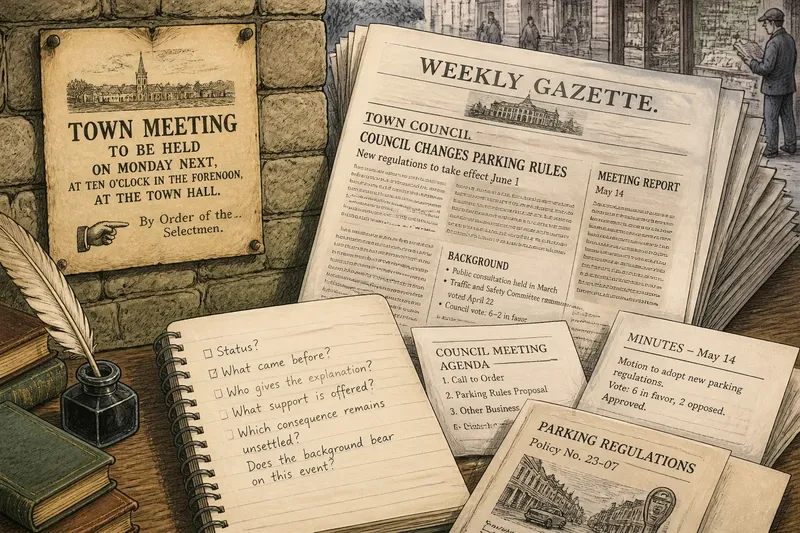
Start with the structure in front of you rather than treating every omission as a reason to gather more coverage. Write down the opening detail, the voices given space, the background treated as settled and any question the report leaves open. Then decide which of those choices most affects your understanding.
- Opening: If the first detail is clearly linked to the issue in the later account, treat it as a supported entry point; if that link is never explained, hold it as an isolated lens and avoid using it to describe the whole dispute.
- Voice order: If the report lets affected people explain their own positions, note what those speakers actually say; if their views are only summarised, separate the reporter’s account of them from their own words.
- Prominence: If a group receives detailed treatment, consider how its perspective shapes the story; if another affected group gets only a passing mention, mark that perspective as limited rather than assuming it agrees.
- Background: If the report explains who made a decision and what constraints applied, use that context to assess the choice; if it does not, leave the decision’s rationale open rather than treating it as inevitable.
- Labels: If a term is attributed or explained, read it in that stated sense; if its meaning is left vague, avoid adopting the label as a neutral description.
- Certainty: If the report distinguishes a direct assertion from an attributed claim or possibility, preserve those distinctions in your own account; if it does not, do not turn an uncertain point into a settled fact.
Say you read a report about a council’s proposed street change. Its opening focuses on the council’s reasons, traders appear in one brief sentence, and the account does not say what alternatives were considered. Your notes would record the opening as the dominant lens, traders’ views as thinly represented, and the available alternatives as unknown. The result is not a verdict that the report is unfair; it is a precise description of what its framing lets you assess and what it leaves unresolved.
News framing is easier to judge when you separate accuracy from selection and selection from emphasis. A report may state its included facts accurately while giving little room to other relevant perspectives. Keep those distinctions in mind, and “neutral” wording becomes less important than the choices the story makes visible—and the questions those choices leave open.